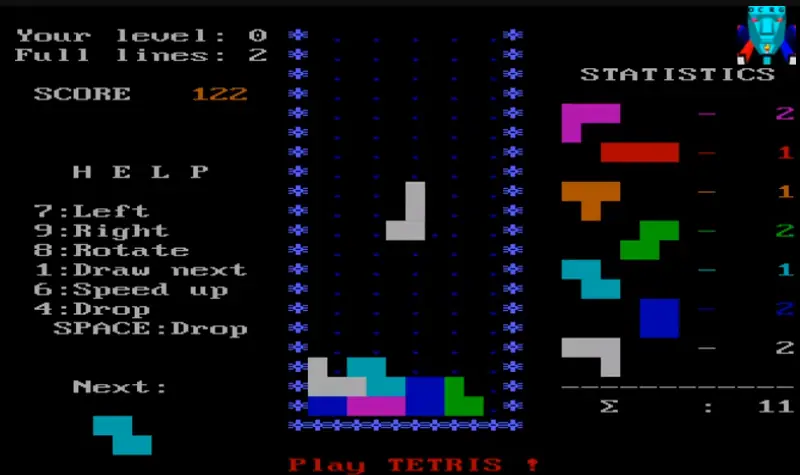
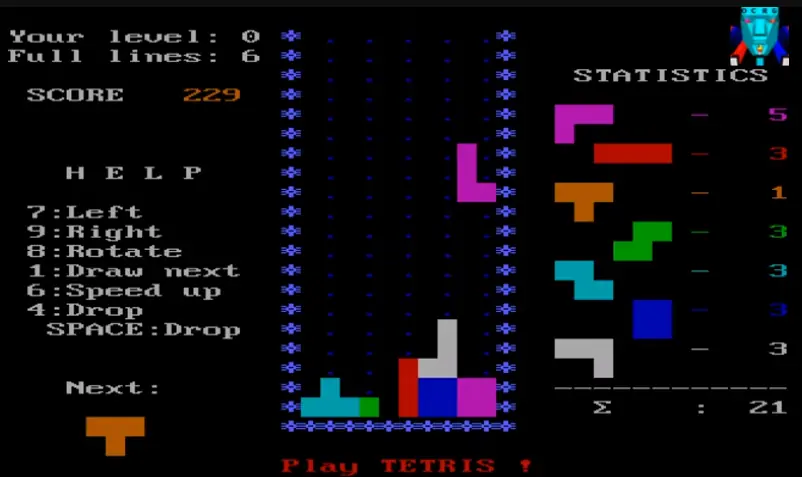
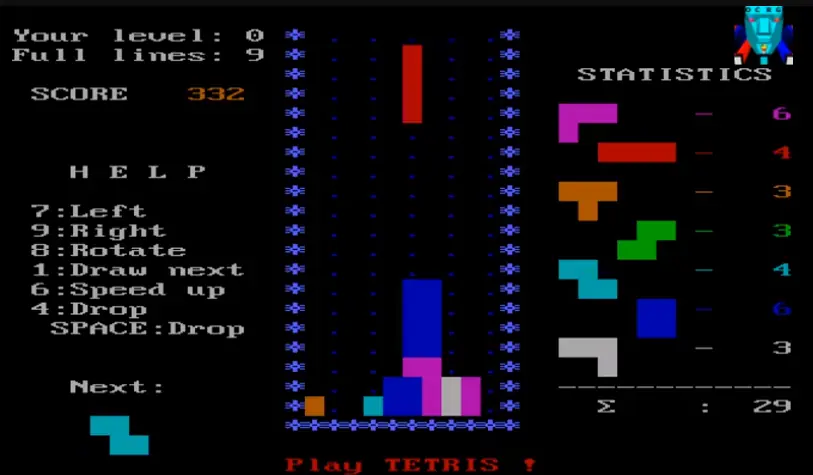
Across its numerous versions, Tetris generally has a consistent puzzle video game design. Gameplay consists of a rectangular field in which pieces consisting of four connected blocks, called tetrominoes, descend one at a time from the top-center. During the descent, the player can move the piece horizontally and rotate it until it touches the bottom of the field or another piece. The player's goal is to stack the pieces in the field to create horizontal lines of blocks. When a line is completed, it disappears and the blocks placed above fall one row. The speed of the descending pieces increases as lines are cleared. The game ends if the accumulated pieces in the field block other pieces from entering the field, a process known as "topping out". Common mechanics among Tetris versions include the queue (viewing the pieces that are next to appear), soft drop (increasing the descent of the piece), hard drop (instantly placing the piece as far down as it can go), and holding (reserving a piece for later use).
The objective of Tetris is to collect as many points as possible during a gameplay session by clearing lines. Tetris's scoring system has remained mostly consistent since Tetris DS (2006) with some exceptions. Points gained during gameplay increase with the descent speed. The more lines cleared at once, the higher the score for a line clear. Completing four horizontal lines at once by placing an I-shaped tetromino into a single-column gap is referred to as a "Tetris"; most versions award the highest score for it. The player can also gain points by using hard drops or soft drops. Advanced techniques, often used in competitive play, include T-spins (spinning a T-shaped tetromino into a blocked gap), perfect clears (emptying the field following a line clear), and combos (clearing lines consecutively).
Tetris is abandonware and no longer sold or supported by its publishers. Files are archived here for these platforms:







Comments